
Accounting Interview Questions & Answers for Freshers: 50+ Practical Questions for 2026
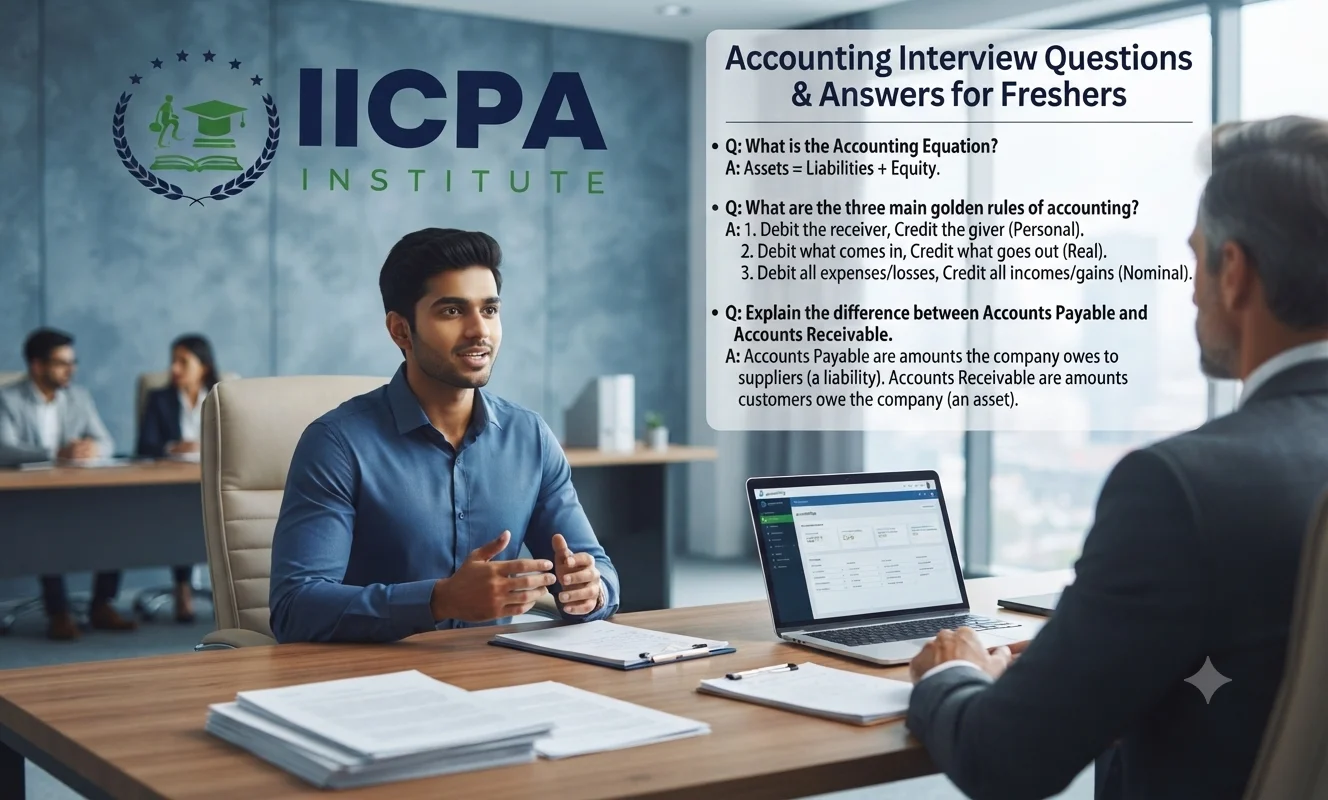
Comprehensive Guide for B.Com Graduates, Accountants, and Finance Freshers | IICPA Institute
Stepping into the corporate world as a B.Com graduate or a finance fresher can feel both exciting and overwhelming. Whether you are actively searching for accounting jobs for freshers, preparing for an accounts executive interview, or exploring broad B.Com accounting jobs, cracking your first interview requires a robust command of fundamentals, practical software proficiency, and statutory compliance. Modern corporate employers do not merely look at textbook memorization; they evaluate job-ready candidates who understand everyday business workflows.
|
Key Takeaway: Industry Insight for 2026: Employers increasingly prioritize candidates who can seamlessly transition from manual bookkeeping to automated accounting software and modern tax portals on day one. |
Part 1: Basic Accounting & Fundamental Interview Questions
When panels ask basic accounting interview questions, they want to test how deeply you understand the core mechanics of financial statements. Here are the most essential concepts you must master:
Q1. What is the fundamental accounting equation and why is it critical?
Answer: The entire architecture of double-entry bookkeeping rests upon the immutable accounting equation:
Assets = Liabilities + Owner's Equity (Capital)
This equation must perpetually balance because every single business transaction has a dual aspect—affecting both sides of the balance sheet equally. For instance, if a business purchases equipment for cash, one asset increases while another asset decreases, keeping the equation in equilibrium.
|
Core Formula: Assets = Liabilities + Capital. Every transaction impacts at least two accounts to keep this equation in perfect balance. |
Q2. What are the Golden Rules of Accounting under traditional classification?
Answer: The traditional golden rules govern how every financial transaction is categorized and recorded:
1. Personal Account: Debit the receiver, Credit the giver.
2. Real Account: Debit what comes in, Credit what goes out.
3. Nominal Account: Debit all expenses and losses, Credit all incomes and gains.
Mastering these rules allows freshers to solve complex ledger posting queries instantly during any technical round.
Q3. What is the difference between bookkeeping and accounting?
Answer: Bookkeeping is primarily a transactional and clerical phase focused on systematically recording, sorting, and storing financial documents and day-to-day entries. Accounting is a much broader, analytical discipline that encompasses summarizing, interpreting, analyzing, and reporting financial data to management and external stakeholders for strategic decision-making.
Part 2: Journal Entry & Ledger Interview Questions
Interviewers frequently test candidates on practical scenario-based journal entry interview questions to evaluate your day-to-day working accuracy.
Q4. How do you pass journal entries for goods purchased on cash versus credit?
Answer:
• Cash Purchase: Debit Purchase Account, Credit Cash/Bank Account.
• Credit Purchase: Debit Purchase Account, Credit Creditor/Supplier's Personal Account.
Understanding whether a transaction impacts cash liquidity or creates an accounts payable liability is vital for accurate financial reporting.
Q5. What is a compound journal entry? Give a practical corporate example.
Answer: A compound entry involves multiple accounts on the debit side, credit side, or both in a single transaction. For example, settling an invoice of ₹10,000 with a supplier by paying ₹9,800 in cash and receiving a ₹200 cash discount:
- Debit Supplier's Account: ₹10,000
- Credit Cash Account: ₹9,800
- Credit Discount Received Account: ₹200
|
Best Practice Tip: Compound entries combine multiple accounts into a single cohesive transaction line, reducing redundancy in accounting ledgers. |
Part 3: Tally ERP & Software Interview Questions
In modern Indian and global accounting environments, proficiency in ERP systems is mandatory. Expect dedicated Tally interview questions during screening rounds.
Q6. What is Tally, and how many pre-defined ledgers are created by default when opening a new company?
Answer: Tally is an industry-standard accounting software used for financial record keeping, inventory management, and statutory compliance. By default, when you create a new company in Tally, exactly two ledgers are pre-defined:
1. Cash (under Cash-in-Hand)
2. Profit & Loss Account (under Primary Group)
Q7. Differentiate between Payment, Receipt, and Contra Vouchers in Tally.
Answer:
• Payment Voucher (F5): Used for recording all cash or bank outflows (e.g., paying rent, salaries, or creditors).
• Receipt Voucher (F6): Used for recording inflows of funds (e.g., receiving cash from customers or bank interest).
• Contra Voucher (F4): Used exclusively for internal fund transfers between cash and bank accounts, such as cash deposited into a bank or withdrawn from an ATM.
Part 4: GST & Taxation Interview Questions
Taxation knowledge distinguishes an average candidate from a top-tier hire. Preparing for GST interview questions is essential for any accounts executive role.
Q8. What is GST, and what are its primary components?
Answer: Goods and Services Tax (GST) is a comprehensive, multi-stage, destination-based indirect tax levied on the supply of goods and services. Its core components are:
• CGST & SGST: Charged concurrently on intra-state supplies (within the same state).
• IGST: Charged on inter-state supplies and imports (moving across state boundaries).
Q9. What is Input Tax Credit (ITC), and what are the primary conditions to claim it?
Answer: Input Tax Credit (ITC) allows a registered business to reduce the tax liability arising from outward sales by claiming credit for the tax already paid on inward purchases. Key conditions include possessing a valid tax invoice, actual receipt of goods/services, filing of relevant GST returns by the supplier, and timely tax payment to the government exchequer.
|
Tax Concept: ITC prevents cascading tax burdens by ensuring tax is paid only on the value added at each stage of the supply chain. |
Part 5: Advanced & General Accountant Interview Questions
To secure high-paying positions across competitive corporate landscapes, aspiring professionals must master broad accountant interview questions covering working capital, bank reconciliation, and financial auditing.
Q10. What is Working Capital, and why is it important for business liquidity?
Answer: Working Capital is calculated as Current Assets minus Current Liabilities. It measures a company's short-term financial health and operational liquidity. Positive working capital ensures that a firm can easily fund its day-to-day operations and meet short-term obligations without financial distress.
Q11. What is a Bank Reconciliation Statement (BRS), and why is it prepared?
Answer: A Bank Reconciliation Statement is a report prepared by an accountant to match and reconcile the bank balance shown in an organization's cash book with the balance shown in the bank passbook. Discrepancies often arise due to cheques issued but not yet presented for payment, bank charges, or direct deposits made by clients.
Conclusion & Career Roadmap for 2026
Cracking an accounting interview in 2026 requires a blend of theoretical precision, hands-on software competence, and confidence. By mastering these foundational concepts, journal entries, Tally workflows, and GST provisions, freshers can distinguish themselves in any competitive recruitment drive. Institutions like IICPA bridge the crucial gap between academic learning and practical corporate expectations, equipping students with job-ready skills that accelerate career growth from day one.
|
Final Takeaway: Continuous learning and practical software mastery are the definitive keys to unlocking top-tier finance and accounting careers. |
IICPA Course
GST Master Course || Income Tax Master Course || TDS Master Course || PF And ESi Master Course
Ready to Start Your Career With IICPA?
Learn practical Accounting, GST, Income Tax, Tally Prime, Excel, SAP, Power BI, QuickBooks, and job-oriented finance skills through live practical training by industry experts.
Trained & led by CA Poonam Gupta & Adv Lokesh Gupta
© 2026 IICPA Institute|Best Accounting & Finance Training Institute in India
9593330999|iicpaconnect@gmail.com|www.iicpa.in
This blog is published for educational and informational purposes only. For personalized career guidance, course counselling, or admission assistance, please contact IICPA Institute.