Basic Course vs Job Oriented Course – Which is Better?
Overview
Selection of a course is not only about studying; it is much more than that. Many students, graduates, and professionals find themselves confused between joining a general course and choosing job-oriented training.
Both courses offer great significance on their own terms, what matters the most is which course actually lands you a lucrative job along with good pay packages and a bright career ahead.
To achieve success by making the right choice, it is important to understand the difference between both. In this blog post, we will be discussing both options in detail and explaining the reason behind the growing preference for job-oriented training offered by institutions such as IICPA.
Reality Check
Let’s get real.
The job market is highly competitive today. Every year, lakhs of graduates with commerce, BBA, MBA and other degrees enter the workforce—many of whom remain unemployed or underpaid.
Why?
Simply because holding a degree doesn’t matter anymore.
Companies don’t ask,
“What did you study?”
They ask,
“What can you really do?”
That’s where things get tricky for most students.
The Major Problem Faced by the Students
Most students usually follow a conventional path:
Education → Higher education → Degree → job search
But after getting their education over, they find themselves in the below situation:
Unable to work with real projects
Unable to use accounting software
Lack knowledge about practical procedures like GST filing or payroll
Unable to handle themselves in interviews
The biggest shock comes from here—
Rejection from companies due to lack of practical skills
What is a Basic Course?
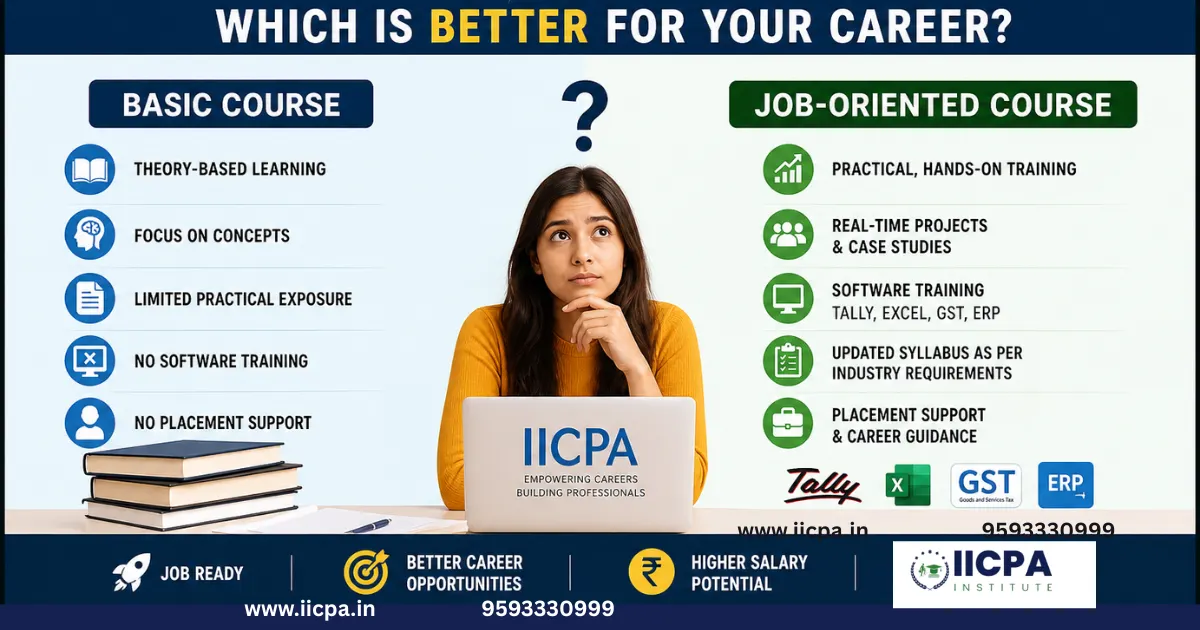
A basic course focuses primarily on theoretical understanding. It builds foundational knowledge and helps students learn the core principles of a subject.
Key Features of Basic Courses:
Considers basic principles and concepts
Theoretically inclined rather than practically inclined
Lack of practical situations exposure
Lack of training in industry-specific software programs
No job placement assistance is provided
Test-based learning process
Unchanging syllabus, which is rarely updated
Less attention is paid to skills
Example:
Traditional accounting courses that teach:
Journal entries
Ledger posting
Trial balance
Financial statements
However, students often don’t learn how these concepts are applied in real business environments.
Market Transformation—Skills Have Become the Currency!
We live in an era of skills.
Organizations need:
Employees skilled in working with Tally and Excel
Candidates capable of filing GST returns
Individuals with knowledge about practical business deals
Staff members who do not require extensive training
In plain language:
Organizations want "ready-to-work" individuals
What is a Job-Oriented Course?
A job-oriented course is designed with one clear goal: to make students industry-ready. It combines theoretical concepts with practical, hands-on training so that learners can perform real job tasks confidently.
1. Learning That’s Practical and Relevant
No theoretical lessons here—only doing what professionals do:
Preparing GST returns
Calculating TDS
Processing payroll
Making actual accounting entries
2. Software Skill Training
Technology is the backbone of modern accounting. Being ignorant of it means you start off behind.
Training includes:
Tally Prime
Excel Advanced
GST Portal
Income Tax software
ERP systems
3. Business Experience
Theoretical learning isn’t enough. Job-oriented courses ensure you get exposure through:
Live projects
Case studies
Practical assignments
4. Career Assistance
Where other educational institutions falter, job-oriented courses excel.
Offering:
Help with resumes
Interview guidance
Job placements
Placement drives
5. Quick Career Kick-Start
No more delays. No more guesswork.
After completing the course, you’ll be ready to: Work right away

Why Job-Oriented Courses Are the Better Choice Today
1. Industry Demands Practical Skills
Today’s employers are not just looking for degrees—they want skills. Companies expect candidates to start working from day one without requiring extensive training.
A job-oriented course ensures you:
Know how to file GST returns
Handle payroll and TDS
Work on accounting software
Manage real business transactions
2. Faster Entry into the Job Market
Students who complete job-oriented training can quickly secure employment because they already possess the skills required by employers.
Instead of spending months searching for a job, you become job-ready immediately.
3. Hands-On Experience with Software
Modern accounting is fully digital. Without software knowledge, it’s nearly impossible to survive in the industry.
Job-oriented courses provide training on:
Microsoft Excel (Advanced)
GST Portal
ERP Systems
This makes you efficient, accurate, and productive.
4. Real-World Exposure
Unlike basic courses, job-oriented programs simulate real work environments. You learn through:
Case studies
Live projects
Practical assignments
This bridges the gap between learning and earning.
5. Higher Salary Opportunities
Employers are willing to pay more to candidates who can deliver results from day one.
With job-oriented training, you can:
Start with a better salary
Get promotions faster
Explore multiple career options
6. Placement Support and Career Guidance
One of the biggest advantages of job-oriented courses is placement assistance.
Institutes like IICPA provide:
Resume preparation
Interview training
Job referrals
Placement drives
This significantly increases your chances of getting hired.
7. Confidence Boost
When you have practical knowledge, your confidence automatically increases.
You can:
Crack interviews easily
Handle real work pressure
Communicate professionally
Why Choose IICPA for Job-Oriented Courses?
When it comes to professional accounting and taxation training, IICPA (Institute of Career in Professional Accounting) stands out as a trusted name.
What Makes IICPA Different?
✔ Industry-Focused Curriculum
Courses are designed based on current market needs, ensuring you learn what companies actually require.
✔ Practical Training Approach
IICPA emphasizes learning by doing, not just theory.
✔ Expert Faculty
Learn from professionals with real industry experience.
✔ Complete Software Training
Hands-on training in:
Tally
Excel
GST
Income Tax
Payroll
✔ 100% Job Assistance
Dedicated placement support to help students start their careers.
✔ Real-Time Projects
Work on practical assignments that reflect real business scenarios.
✔ Flexible Learning Options
Online and offline classes available for convenience.
Career Opportunities After Job-Oriented Courses
After completing a job-oriented accounting course from IICPA, you can explore roles such as:
Accountant
GST Practitioner
Tax Consultant
Accounts Executive
Payroll Executive
Audit Assistant
Finance Executive
These roles are in high demand across industries like:
Manufacturing
IT companies
CA firms
Startups
Corporate businesses
When Should You Choose a Basic Course?
Although job-oriented courses are highly beneficial, basic courses still have their place.
You can choose a basic course if:
You are at a beginner level and want conceptual clarity
You plan to pursue higher academic studies
Your focus is on theoretical knowledge
However, it is always recommended to combine basic knowledge with practical training for better career outcomes.
Smart Strategy: Combine Both
The best approach is not to choose one over the other—but to combine both.
Start with:
Basic concepts
Then move to job-oriented training
This ensures:
Strong foundation
Practical expertise
Better career opportunities
Final Verdict – Which is Better?
If your goal is:
Getting a job quickly
Earning a good salary
Building a successful career
Job-oriented courses are clearly the better choice.
Basic courses may give you knowledge, but job-oriented courses give you skills, confidence, and opportunities.
Conclusion
In the current world, where skills play an essential role, theoretical knowledge isn't enough. The current world needs people who can do things rather than explain them.
A course that focuses on employment ensures:
Hands-on experience
Software proficiency
Experience
Job placements
It’s time that educational institutions such as IICPA started playing their due part in making sure people's careers are successful through their training programs.
Thus, it’s time that you invested in your future by learning the right skills.